Since 19 June 2026, a new obligation applies to every EU e-merchant that sells to consumers: displaying on their site a dedicated button allowing the exercise of the right of withdrawal. This is not a recommendation, it is the law, and the penalties are now applicable.
This change is discreet but sweeping. The directive that introduced it was framed around financial services concluded at a distance. EU lawmakers used that vehicle to add a horizontal requirement covering all B2C contracts concluded online across the 27 Member States. Here is what you need to know.
A European obligation across the 27 Member States
19 June 2026 is not an isolated national date: the obligation stems from Directive (EU) 2023/2673, applicable in the 27 Member States, and the 14-day right of withdrawal is itself harmonised (Directive 2011/83/EU). If you sell to consumers in several EU countries, it is the law of each customer's country of residence that applies (Rome I Regulation, Art. 6): each customer's own national law governs their order. BackToMe detects each customer's country and automatically applies the right regime, in their language.
The text that changes everything
The obligation is set out in Directive (EU) 2023/2673, which every Member State has transposed into national law. Before it, the Consumer Rights Directive (2011/83/EU) already defined the arrangements for exercising the right of withdrawal: consumers could withdraw "by any unambiguous means", and the trader could offer an online form.
The key word was could. Optional. An email was enough.
That is no longer the case. Directive (EU) 2023/2673EUR-Lex ↗ introduces a new requirement:
The new requirement (Directive (EU) 2023/2673)
For contracts concluded at a distance by means of an online interface, the trader makes available to the consumer, at no cost to the latter, a functionality enabling them to exercise their right of withdrawal free of charge.
Three words matter: functionality, free of charge, at no cost. Each Member State's transposition then sets out what this means in concrete terms.
Why now?
Directive (EU) 2023/2673EUR-Lex ↗ of 22 November 2023 requires all Member States to guarantee, on online interfaces, "a withdrawal function that is easy to find".
Brussels' objective is clear: to put an end to practices that, without formally prohibiting withdrawal, make it so tedious that the consumer gives up. An email buried at the bottom of the terms and conditions, a PDF form to print, a phone number available during office hours only: all these frictions are now considered unlawful obstacles.
Who is concerned?
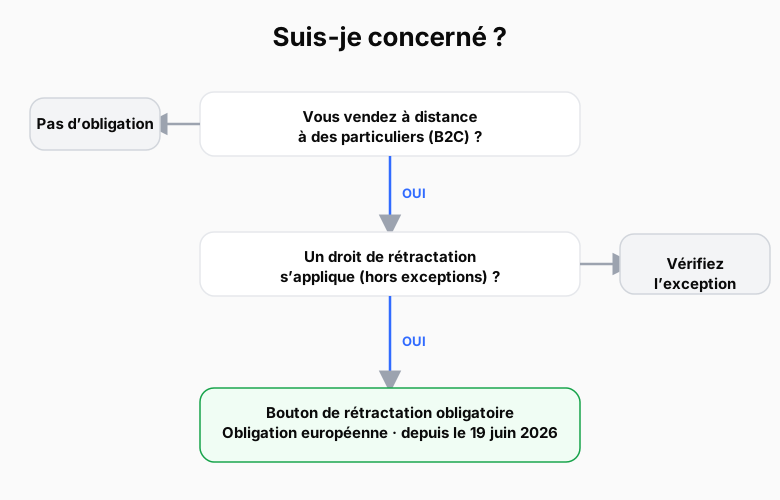
The rule is simple: any sale to a consumer, via an online interface, in the EU (for example: from France). It does not matter how large your business is.
Who is concerned
- E-commerce stores in every sector (clothing, cosmetics, electronics, food, etc.)
- SaaS and subscription software sold to consumers
- Paid online training and courses
- Services booked online (coaching, consultations, etc.)
- Marketplaces and matchmaking platforms
- Sole traders, even with just a few sales a month
The only exceptions are those already provided for by the Consumer Rights Directive (2011/83/EU, art. 16): bespoke goods, perishable products, digital content already downloaded with express consent, pure B2B between professionals. The full list of the 13 cases with concrete examples can be found on the dedicated exceptions page. When in doubt, the cautious rule applies: if you sell to consumers via a website, consider yourself concerned.
The four concrete requirements
The transposition rules set out four criteria the button must meet:
-
Permanently visible throughout the withdrawal period (14 days). A link buried in the terms and conditions is not enough. A floating button at the bottom of the page, yes.
-
Clear and unambiguous wording. In Ireland the official label is "withdraw from contract here", a wording that explicitly says what it allows, without marketing euphemism.
-
Free and easy to use. No premium-rate SMS, no prior registration, no off-putting captcha. The click leads to the form, full stop.
-
Generates an acknowledgement of receipt on a durable medium. As soon as a customer submits their request, you must automatically send them an email back
What happens if you do nothing
Two consequences, one automatic, the other administrative.
The first is the extension of the withdrawal period to 12 months and 14 days. This is the mechanism provided for by the Consumer Rights Directive (2011/83/EU, art. 10), harmonised EU-wide: if the information on the right of withdrawal is not provided under the prescribed conditions, the period is extended by one year. Applied to the button: every sale concluded without a compliant button remains contestable for more than a year. With no recourse for you.
The second is the national regulator's fine. Sanctions are not harmonised across the EU - each Member State sets its own ceiling and designates its own authority. In Ireland, under the Consumer Rights Act 2022, the CCPC can pursue:
- up to €60,000 for an offence
- up to 4% of turnover (or €2,000,000) for widespread, cross-border infringements (EU Omnibus Directive (EU) 2019/2161)
These figures are the Irish example; other Member States set different ceilings. For widespread cross-border infringements, the EU Omnibus Directive lets national authorities impose fines of at least 4% of annual turnover. Details of the CCPC procedure and practical consequences on the dedicated penalties page.
An important clarification
The CCPC fine is not automatic. It comes after a formal notice that has gone unheeded. The extension of the withdrawal period, on the other hand, is automatic and retroactive: no formal notice, no procedure, it applies as of right the moment the obligation is not met.
What to do to be compliant
If you are an e-merchant, here is the minimum checklist:
-
Check that you are concerned. If in doubt, take our diagnostic quiz or visit the help centre.
-
Decide: turnkey solution or in-house development? In-house development costs 3 to 5 days of work plus maintenance with every change to the decree. A solution like BackToMe installs in five minutes and updates automatically.
-
Integrate the button. If you go with a third-party solution, it is a tag to paste into the
<head>of your site. The main CMS platforms (Shopify, WooCommerce, PrestaShop, Wix, Webflow) are all compatible. -
Test. Submit a fake withdrawal from a personal email. Check that the acknowledgement of receipt arrives. Check that the notification reaches you internally.
-
Archive. Keep the evidence. In the event of an inspection, you must be able to demonstrate that the button has been operational since 19 June 2026, with reliable timestamps.
How long does it take?
If you are starting from scratch: count on five minutes with a ready-to-use solution, and between 3 and 5 days for in-house development (design, back-end, email templates, archiving, tests). Add to that the updates with every change to the decree, and the text is recent, so it will evolve.
The 19 June 2026 deadline seems distant but it is not. E-merchants who start taking an interest in it at the end of May risk finding themselves blocked by the queue at their agency or freelance developer.
In summary
- Since 19 June 2026, a withdrawal button is mandatory for all B2C merchant sites across the 27 EU Member States.
- The legal basis: Directive (EU) 2023/2673, transposed by each Member State (the Consumer Rights Directive 2011/83/EU for the 14-day right).
- The requirements: permanent visibility, free of charge, unambiguous wording, automatic acknowledgement of receipt.
- The penalties: withdrawal period extended to 12 months + 14 days (automatic), and a national fine (in Ireland up to €60,000, and up to 4% of turnover for widespread infringements), after a formal notice.
- The most urgent step: check that you are concerned and choose your solution.
BackToMe is designed so that compliance is a tag to copy and paste. It is deliberately a narrow piece of infrastructure, not customer-service software or a CRM: your usual tools (Stripe, e-commerce, support) keep their role. If you prefer to develop your own solution, the comparison of approaches and the official sources will help you scope the project.

Founder of BackToMe
Art. L.221-21 · 19 June 2026
Ready to install the withdrawal feature?
Install the withdrawal button on your site in five minutes. 7-day free trial: 0 € today, 30-day money-back guarantee.
Start the free trial →